
The Shift from Record-Keeping to Intelligent Finance Systems
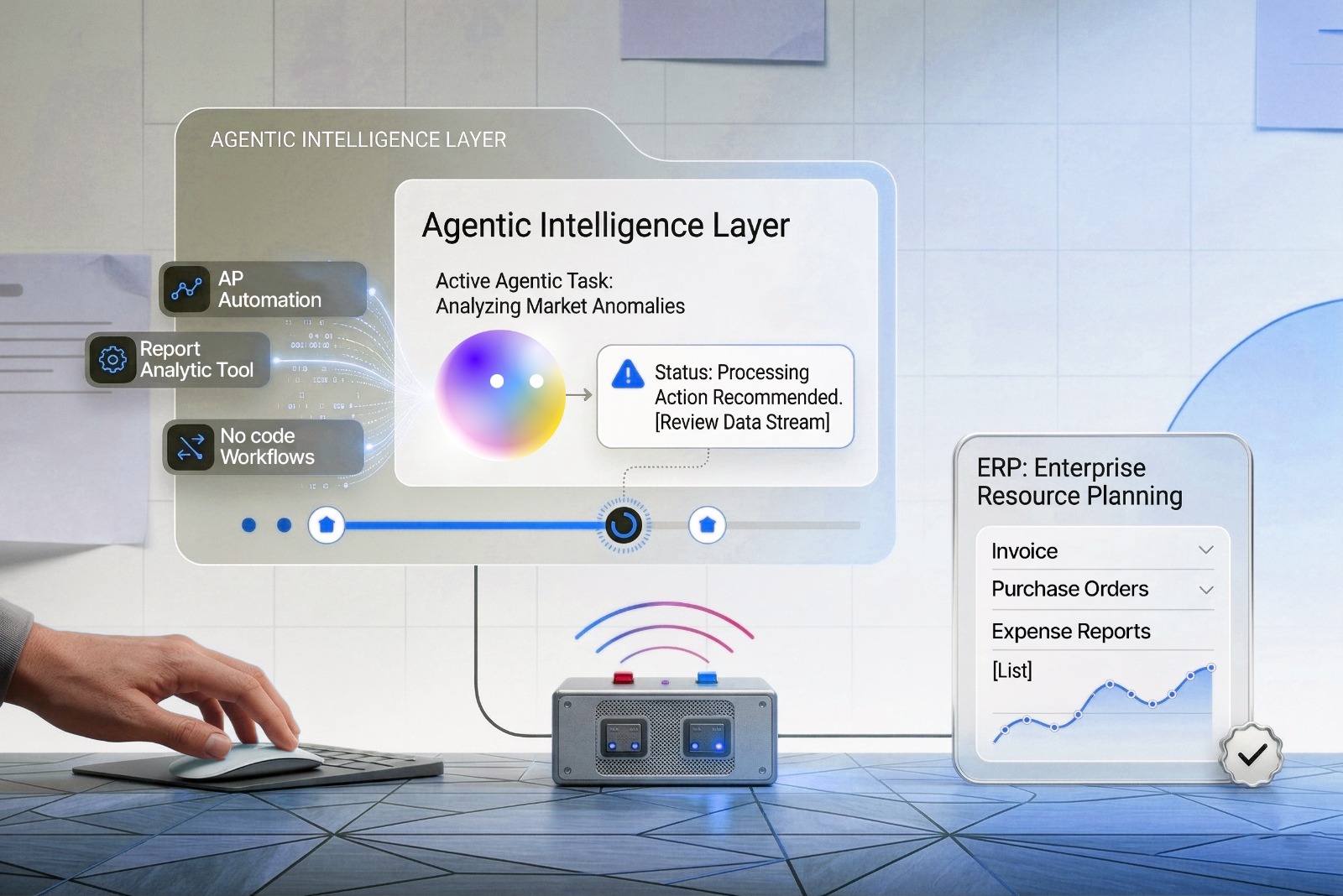
For decades, Enterprise Resource Planning (ERP) systems defined how finance teams operated. Today, that foundation is being augmented by a new paradigm Agentic SaaS for Finance, where systems no longer just record transactions but actively interpret and act on them.
This shift marks the transition from systems of record to systems of intelligence and, ultimately, systems of agency. As highlighted in recent research from McKinsey on AI adoption in enterprises, organizations that operationalize AI not just experiment with it are pulling ahead in efficiency and decision velocity (https://www.mckinsey.com/capabilities/quantumblack/our-insights/the-state-of-ai).
1990s–2000s: ERP Systems of Record
ERP systems were built to centralize enterprise data and enforce consistency across business processes.
Key Characteristics:
- Manual data entry and reconciliation
- Rigid workflows
- Heavy reliance on consultants
- Centralized “single source of truth”
These systems delivered visibility, which was revolutionary at the time. However, they were inherently passive.
Limitations:
- No real-time intelligence
- High dependency on human input
- Reactive rather than proactive operations
ERP systems recorded what happened. They did not influence what should happen next.
2010s: SaaS Expansion and the Integration Tax
The rise of SaaS improved usability and deployment speed, allowing finance teams to adopt specialized tools for procurement, accounts payable, and analytics.
While this shift reduced friction in adoption, it introduced a structural challenge: fragmentation.
Finance teams increasingly operated across disconnected systems, leading to what many leaders now refer to as the integration tax the hidden cost of maintaining and reconciling multiple platforms.
Instead of eliminating manual work, SaaS often redistributed it. Teams spent more time stitching together systems than extracting meaningful insights.
To combat this, modern enterprises are moving toward https://dice.tech/products/expense/ that eliminates the manual reconciliation gap.
2025 and Beyond: Agentic SaaS and Systems of Intelligence
Agentic SaaS represents a fundamental shift in how software operates. According to Gartner’s perspective on agentic AI (https://www.gartner.com/en/articles/what-is-agentic-ai), these systems go beyond automation by introducing decision-making capabilities within software itself.
What Defines Agentic SaaS?
| Capability | Traditional ERP | SaaS Tools | Agentic SaaS |
| Data management | Centralized | Distributed | Unified and contextual |
| Automation | Minimal | Rule-based | Context-aware and adaptive |
| Decision-making | Human-driven | Human-triggered | AI-assisted and autonomous |
| Workflow execution | Manual | Trigger-based | End-to-end autonomous |
| System role | Record-keeping | Process support | Intelligent execution |
Agentic systems do not wait for instructions. They interpret data, identify patterns, and execute workflows across systems without requiring step-by-step human input.
How Agentic AI Transforms Finance Workflows
Consider a common finance scenario: invoice processing.
An agentic system can:
- Detect discrepancies between invoices and contracts
- Cross-reference procurement policies
- Flag anomalies and notify stakeholders
- Initiate vendor communication
- Prepare accounting entries
All of this happens within a continuous workflow, with human involvement reserved for exceptions that require judgment.
Architecture of Agentic Finance Systems
The ability to operate autonomously is rooted in a layered architecture:
1. ERP Core
The foundational system of record for financial and operational data
2. Integration Layer
Connects ERP with banking systems, procurement platforms, and external services
3. AI Decision Layer
Analyzes patterns, detects anomalies, and builds contextual understanding
4. Agent Orchestration Layer
Executes workflows across systems without manual intervention
5. Governance and Control Layer
Ensures compliance, auditability, and policy enforcement
Organizations that invest in clean, integrated data foundations are significantly better positioned to unlock the full value of agentic systems.
Impact on Procurement and Operations
The shift to agentic systems fundamentally changes how procurement and operations teams function.
| Function Area | Traditional Approach | Agentic SaaS Approach |
| Invoice processing | Manual matching and validation | Automated validation and discrepancy resolution |
| Approvals | Sequential and time-consuming | Context-driven and parallelized |
| Exception handling | Reactive and manual | Proactive and AI-driven |
| Supplier management | Transactional | Strategic and insight-led |
| Team focus | Operational tasks | Value creation and optimization |
Rather than eliminating roles, this shift elevates them. Teams move from executing workflows to managing outcomes and strategy.
Why This Shift Matters for the C-Suite
The transition to Agentic SaaS is not simply a technology upgrade it is a competitive advantage.
For CFOs:
- Financial close cycles shrink from weeks to days
- Continuous accounting becomes achievable
- Error rates decline with automated validation
For CIOs:
- Legacy systems remain intact while intelligence is layered on top
- Reduced need for complex system overhauls
- Lower long-term technical debt
For Procurement Leaders:
- Reduced manual intervention
- Improved supplier collaboration
- Greater focus on cost optimization and risk management
The organizations seeing the most impact are not necessarily those with the largest budgets, but those that understand how to operationalize intelligence across their finance stack.
The Competitive Advantage of Systems of Intelligence
Most enterprises today are not constrained by lack of data. They are constrained by their ability to act on it.
Agentic SaaS changes that dynamic by enabling systems to:
- Interpret data in real time
- Execute decisions autonomously
- Scale operations without proportional headcount growth
This is where the next decade of competitive advantage will be built.
Conclusion: The Future of Finance is Autonomous
Finance is moving toward a model where execution is automated and decision-making is elevated.
Agentic SaaS represents the culmination of that evolution:
- Systems handle workflows
- Humans handle strategy
- Intelligence drives outcomes
For organizations that build the right foundation today, this is not a future state it is already becoming standard practice.
FAQs: Agentic SaaS for Finance
Agentic SaaS refers to AI-powered financial systems that can autonomously analyze data, make decisions, and execute workflows without requiring constant human input.
It enhances ERP systems by adding intelligence and automation layers that enable real-time decision-making and autonomous execution of financial processes.
No. While large enterprises benefit significantly, mid-sized organizations can also leverage agentic systems, especially through modular SaaS deployments.
The primary risks include poor data quality and lack of integration. For a deeper look at building a clean foundation, see our Finance Audit & Compliance Guide.
Implementation timelines vary but are typically faster than traditional ERP deployments, especially when layered on existing infrastructure.
